A motor spec sheet can look impressive, but the best eBike motor is not automatically the one with the biggest number. For a rider heading across Jacksonville, cruising Amelia Island, rolling through a neighborhood, or loading up for an RV trip, the right choice comes down to how and where you want to ride. This ebike motor guide turns the technical terms into what they mean when you are actually in the saddle.
A good motor should make riding feel easier, not complicated. It should help you pull away smoothly at a stoplight, keep pace into a coastal headwind, handle a bridge or loose trail section, and leave you with enough battery for the ride home. That is why a test ride matters as much as the wattage printed on a product page.
Start With Your Real Riding Routine
Before comparing motors, think about the moments when you want assistance. A flat, five-mile commute with a backpack asks for something different than a weekend ride on sand, a long-distance rail trail outing, or a hilly route with a loaded rear basket.
For many Northeast Florida riders, a quality rear hub motor is an excellent match. It offers dependable push from the back wheel, straightforward operation, and plenty of help for paved paths, neighborhood streets, hard-packed dirt, and everyday errands. Pair it with wider tires and the right power level, and it can also be a confident choice for beach access areas and relaxed off-pavement exploring.
If you expect frequent hills, technical terrain, or longer rides where efficient battery use is a major priority, a mid-drive motor deserves a close look. It works through the bike’s drivetrain instead of pushing the wheel independently. That difference changes how the bike climbs and how naturally it responds when you shift gears.
Hub Motors: Easy Power for Everyday Miles
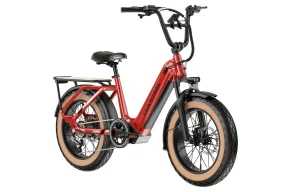
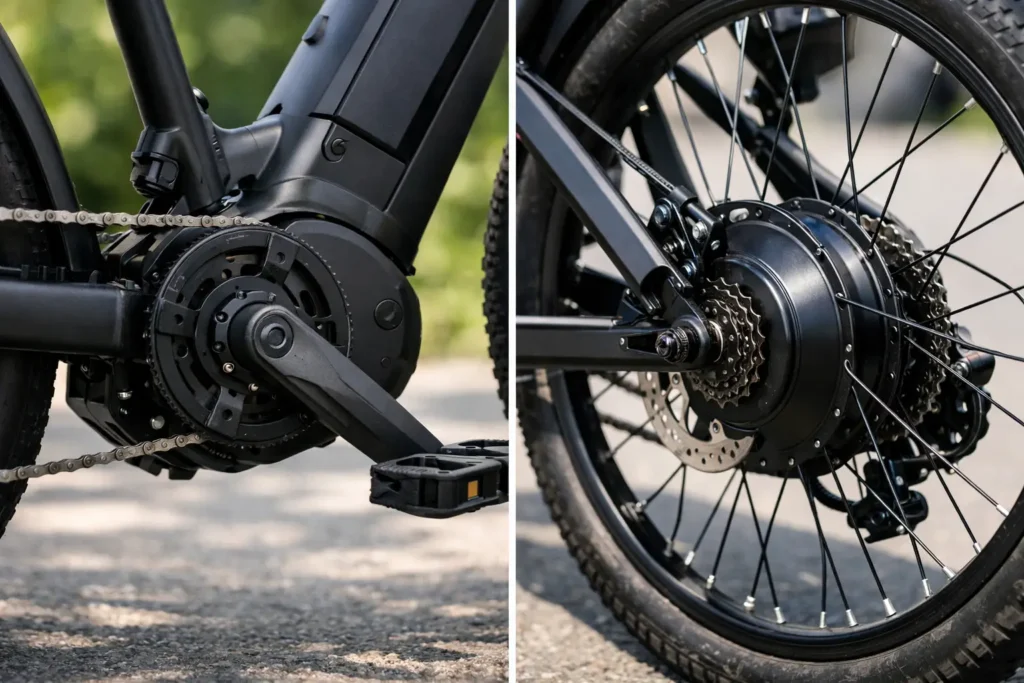
Most first-time riders will encounter hub motors first, especially on commuter, folding, fat-tire, and step-through eBikes. A hub motor sits at the center of the wheel, most commonly the rear wheel. When you pedal or use the throttle, the motor turns that wheel to help move the bike forward.
The appeal is simple: hub motors make an eBike approachable. There is no special riding technique required. Select a pedal-assist level, begin pedaling, and feel the bike take some of the work off your legs. On models with a throttle, you can also get moving from a stop without pedaling right away. That can be especially useful at intersections, when carrying cargo, or when your knees need a break.
Rear hub motors also keep their power delivery separate from the chain and gears. That can mean less drivetrain wear compared with a mid-drive under hard climbing loads. For flat to moderately rolling routes, recreational rides, and practical transportation, the combination of simple operation and strong acceleration makes a rear hub motor hard to beat.
The trade-off is on steep or slow climbs. Because the hub motor does not benefit from your bike’s gears, it has to work harder in those situations. This is less of a concern on most local streets, but it matters if your adventures regularly include significant elevation, deep sand, or demanding off-road terrain.
What About Front Hub Motors?
Front hub motors exist, but they are less common on quality all-around eBikes. Putting motor power at the front wheel can affect traction on wet pavement, loose ground, or sand, particularly when accelerating. A rear hub motor generally feels more planted and intuitive because the powered wheel carries more of the rider’s weight.
Mid-Drive Motors: Better Climbing and a More Natural Feel
A mid-drive motor is mounted near the pedals, at the bike’s crankset. Instead of directly spinning a wheel, it adds power to your pedaling through the chain and gears. Shift to an easier gear on a climb, and the motor can use that lower gear too. The result is strong hill performance and efficient power delivery at a wide range of speeds.
Many experienced riders enjoy how connected a mid-drive feels. It rewards shifting and pedaling much like a traditional bicycle, just with much more support. The motor’s central position also keeps weight low and balanced, which is valuable on a full-suspension eBike, uneven trails, and tighter turns.
There is a trade-off. Mid-drives place more force on the chain, cassette, and other drivetrain parts, so good shifting habits and routine maintenance matter. They also tend to cost more. For riders who mostly cruise flat paved routes, that added capability may not be necessary. But for frequent hills, ambitious distances, or riders who want the most bicycle-like performance, a mid-drive can be worth it.
Watts Tell Part of the Story
Motor wattage is useful, but it is not a complete answer to how an eBike will feel. Watts measure electrical power. A 500-watt motor can be more than enough for many commuters and casual riders, while higher-powered systems can offer more authority for heavier loads, sand, headwinds, and steeper terrain.
Ask whether a number refers to nominal or peak wattage. Nominal wattage describes the power a motor is designed to sustain. Peak wattage is the higher output it may reach briefly during acceleration or climbing. Both can be relevant, but neither should be used alone to compare two bikes.
Motor tuning, controller settings, rider weight, tire size, terrain, and battery voltage all influence real-world performance. A well-matched 750-watt system can feel more useful than a poorly tuned motor with a bigger number attached to it. The goal is controlled, confident assistance, not a spec sheet race.
Torque Is What You Feel at the Stoplight
Torque, measured in Newton-meters or Nm, is the twisting force that gets a bike moving and helps it hold speed under load. If watts describe available power, torque often describes that satisfying push you notice when starting from a stop or climbing.
More torque is helpful for riders carrying groceries, using a child or cargo setup where appropriate, tackling a bridge, riding into a strong wind, or moving a fat-tire eBike through softer ground. It can also make a larger rider feel better supported. Still, more torque is not always better if the motor engages abruptly. Smooth, predictable delivery is safer and more comfortable, especially for new riders.
During a test ride, start and stop several times. Try different assist levels. Pay attention to whether the motor comes on gradually and whether you can maintain an easy line through a turn. Those details say more about ride quality than a single torque figure.
Pedal Assist, Sensors, and Throttles
Pedal assist is the system that tells the motor when and how much to help. Cadence sensors detect that the pedals are turning. They are simple and effective, often delivering assistance soon after you begin pedaling. They work well for relaxed riding and riders who want easy, low-effort support.
Torque sensors measure how hard you are pressing on the pedals. They can provide a more proportional response: gentle pressure brings gentle help, while stronger pedaling calls for more assistance. Many riders describe this as a smoother, more natural experience.
A throttle is another useful tool, not a replacement for pedaling. It can help you pull away smoothly, cross an intersection, or rest your legs for a moment. If a throttle is important to you, test it from a full stop and at low speed. You want a response that feels controlled, not jumpy.
The Motor and Battery Work as a Team
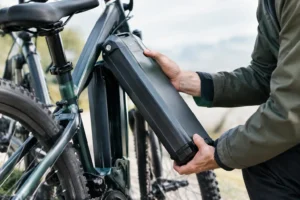
Even the strongest motor depends on the battery behind it. Battery capacity is usually measured in watt-hours, and more watt-hours generally means more potential range. But actual range changes with assist level, terrain, rider and cargo weight, wind, tire pressure, temperature, and how often you use the throttle.
A powerful motor used at maximum assist will drain a battery faster than the same bike ridden in a moderate setting. That does not make high power a bad choice. It simply means you should select a battery that fits your longest expected rides and your preferred level of assistance.
For many riders, it is smarter to buy enough battery for real life rather than constantly stretching every charge. If you want to explore farther, commute without range anxiety, or use the bike for errands, consider your round-trip distance plus a comfortable reserve.
Choose the Motor That Makes You Want to Ride
The best motor is the one that supports your independence, comfort, and favorite kind of fun. A rear hub motor may be perfect for a relaxed step-through cruiser, a folding eBike for travel, or a reliable daily commuter. A high-torque fat-tire setup may suit coastal exploring and mixed terrain. A mid-drive may make sense when hills, longer distances, and performance are at the center of your plans.
At GO EBIKES, the most useful next step is simple: test ride before you make your decision. Feel how the motor starts, climbs, corners, and responds at different assist levels. Bring up the routes you ride, the cargo you carry, and any comfort concerns. The right eBike should leave you thinking less about the motor and more about where you can go next.